From signals to verified action — in one operational stack.
ZionDome is built as an end-to-end wildfire resilience system: data ingestion → AI models → digital twins and scenarios → playbooks → verification → evidence packs for stakeholders and underwriters.
The ZionDome stack at a glance
1) Data layer
We fuse multiple sources into one time-aligned picture:
- Satellite and aerial imagery (change detection, fuel patterns, hotspots)
- Weather and forecast signals (wind, humidity, temperature, drought indices)
- Vegetation and terrain context (fuel continuity, slope, exposure)
- On-site sensors where applicable (risk thresholds, operational status)
- Operator inputs and inspection logs (verification and maintenance history)
2) AI layer
Computer vision + geospatial AI
Our models transform imagery and signals into actionable insights:
- Detection and segmentation (risk features, exposure drivers)
- Risk scoring and prioritization (what matters most for each asset)
- Early warning classification (when to escalate)
- Draft case file generation for prevention workflows (with human verification)
Human-in-the-loop verification
For decisions that require legal defensibility (municipal workflows) or underwriting trust, the system is designed around:
- Confidence scoring and evidence traceability
- Review/approval steps and audit logs
- Clear “why this was flagged” explanations
3) Digital Twin + Scenario Engine
Asset-level digital twin
We build a 3D representation of each site:
- Building geometry + critical zones
- Terrain and exposure directions
- Vegetation and defensible space context
Scenario analysis
We run scenario-based analysis to identify “failure points” and action priorities:
- Wind-driven ember pathways
- Radiant heat exposure zones
- Operational response timing impacts
This produces a ranked mitigation plan and clear thresholds for deployment.
4) Supercomputer (HPC) training & simulation
To scale from pilots to portfolios and regions, ZionDome uses high-performance computing for:
- Training and validating computer vision and geospatial models on large imagery archives
- Running scenario sweeps across many weather/wind/fuel permutations
- Stress-testing system behavior for rare but high-impact conditions
We leverage EuroHPC-class GPU and CPU resources EuroHPC Joint Undertaking to accelerate model iteration, uncertainty analysis, and portfolio-level evaluation — while keeping deployment outputs compact and operational.
Key principle: HPC is for training and scenario exploration; real-world operations run on practical infrastructure with resilient fallbacks.
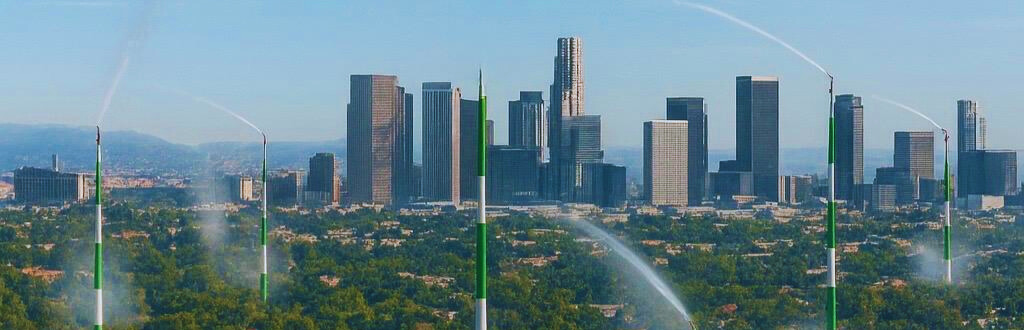
5) On-site protection layer (“Rain Towers” + deployables)
When conditions peak, active defense can be the last line of protection:
- Rapid-deploy water/mist curtains for exposure edges
- Portable units for highest-value zones (utilities, garage, safe room, key assets)
- Operational readiness checks and playbooks tied to thresholds
6) Reliability, diagnostics, and “moment-of-truth” readiness
Wildfire tools become critical when something goes wrong. ZionDome is engineered for fast fault isolation:
- Device health monitoring (heartbeat, self-tests, telemetry)
- Guided triage to separate power/comms/device faults vs. software pipeline issues
- Playbooks and escalation paths designed for urgent resolution
7) Evidence loop and reporting
ZionDome turns actions into shareable, audit-friendly artifacts:
- Before/after risk state
- Time-stamped logs and documentation
- Verification status and maintenance history
- Underwriting-ready summaries and portfolio views
8) Security and governance
- Role-based access control (operator / municipal reviewer / insurer view)
- Audit trails for changes, decisions, and verification steps
- Data ownership clarity and privacy-by-design principles
Call to action
Want the technical architecture or a pilot blueprint?
We can share a pilot plan, data inputs, and the exact evidence outputs you’ll receive from day one.
Book a Demo • Get a Quote